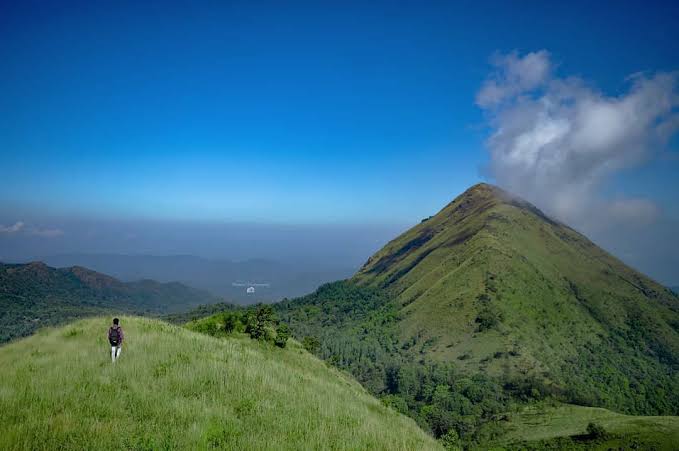
Some trips need planning, and some just need a long weekend and enough bikes. The Gandhi Jayanti break on 2nd October gave us three days with no real obligation, and nine of us decided to point ourselves toward Kalasa — a small temple town in Chikkamagaluru district where the Western Ghats get properly dense and the air smells like wet earth and wild cardamom. The draw was Merthi Gudda, a peak sitting at roughly 2,000 metres above sea level that’s been gaining traction among Bangalore’s weekend trekking crowd without yet attracting the queues and permit hassles of the more famous Karnataka summits. Six bikes, three pillions, one WhatsApp group with too many voice notes, and a loose plan that mostly amounted to “ride there, trek up, figure out the rest” — that was the entire itinerary going in, and honestly it held up better than most spreadsheet-planned trips I’ve been on.
Day 1: Bangalore to Kalasa via Hassan
We rolled out of Bangalore somewhere around 6:30 a.m. on the morning of 2nd October. Six bikes in a loose convoy through the city’s early-morning traffic, which at that hour on a national holiday was about as forgiving as Bangalore traffic ever gets. The first proper stop was Hassan, roughly three hours down NH 75. We actually ended up eating twice there, which is exactly as good as it sounds. The first stop was Swati Delicacy, a local restaurant where we sat down for a proper breakfast before continuing further into town. The second stop was at Sonika’s place — a friend and colleague who lives in Hassan and had offered to host us for a bit on the way through. She’d set out pulav, jamun, and bondas, the kind of spread South Indians are quietly hardwired to appreciate, and nine people who’d been on bikes since 6:30 a.m. did not need to be asked twice. Hassan itself is one of those Karnataka towns that most Bangalore riders blow past on the way to Chikmagalur or Sakleshpur, but between Swati Delicacy and Sonika’s hospitality, it earned its place as more than just a fuel stop on this trip.
From Hassan, we picked up the route toward Belur and then cut southwest toward Kalasa. The roads through this stretch are the kind that remind you why a bike trip beats a car for this part of Karnataka — narrow enough that the canopy closes over in places, with the occasional sharp turn that opens up into a valley view you weren’t expecting. The ride quality stays decent through most of it, though the last thirty-odd kilometres into Kalasa throw in a few patches where the monsoon has done its usual editorial work on the tarmac.
We pulled into Kalasa at around 4 p.m. — roughly nine and a half hours door to door from Bangalore, including the long breakfast halt. For a ride of that distance, it didn’t feel punishing. The last hour of approach, winding through areca and coffee plantations with the Ghats filling the windshield, does a lot to take the edge off any fatigue that’s built up.
The stay: Merthi Gudda Homestay
We’d booked Merthi Gudda Homestay, a small property close enough to the trailhead that the next morning’s trek wouldn’t require an early-morning drive on top of the hike. The cost came to ₹1,700 per head per night, which for two nights worked out to ₹3,400 (give or take the usual rounding that happens when nine people try to split bills on GPay). For a homestay in this part of Karnataka during a long weekend, that’s a reasonable rate — not the cheapest floor-and-mattress setup, but nowhere near the boutique-stay pricing that some of the trendier Chikmagalur properties have started charging.
The property itself was simple and functional: clean rooms, enough hot water for nine people to cycle through showers without a mutiny, and a host who clearly knew the area well enough to brief us on the trek route without needing to pull up Google Maps. There’s no resort-style landscaping or infinity pool here — the setting does the work, and the setting is a hillside in the Western Ghats surrounded by the kind of green that only exists in places that get properly rained on for four months straight.
Evening of Day 1: the jhari and the leeches
After dumping bags and sorting out rooms, the nine of us went exploring the area around the homestay before the light dropped. A short walk downhill turned up a small jhari — a narrow stream of water flowing through rocks and moss, not quite a waterfall but more than a trickle, the kind of incidental water feature that wouldn’t make any travel guide but was exactly what tired legs needed after a full day on a bike. We found a good spot, pulled off shoes, and soaked our feet in the cold water while the forest did its thing around us.
The leeches showed up about ten minutes in. This is Malnad country in the weeks just after monsoon, so leeches aren’t a surprise — they’re a guarantee. Small, persistent, and weirdly stealthy, they made their presence felt on ankles and between toes, prompting the usual round of controlled panic, salt applications, and “wait, is that one on you too?” conversations that are apparently mandatory on any Western Ghats trip between September and November. Nobody got dramatically bled, but a few of us carried small red souvenirs back to the homestay as proof of encounter. If leeches genuinely bother you, long socks tucked into trousers and a salt shaker in your daypack are the standard Malnad precautions — they work, mostly.
We came back to the stay, cleaned up, and spent the rest of the evening doing what groups of nine do at a homestay with no TV and patchy cell signal: talking, eating whatever the host put in front of us, and going to bed early enough to not regret the next morning’s alarm.
Day 2: The Merthi Gudda trek
The trek was the whole point of the trip, and it delivered. We started the climb at around 8:30 a.m. after a quick breakfast, and the trail from near the homestay heads more or less straight up through dense forest before thinning out into grassland and exposed rock as you gain altitude. The path is reasonably well-marked — there’s enough foot traffic now that the route is obvious for most of the climb — but it’s steep enough in places that anyone who hasn’t walked uphill in a while will feel it in their calves within the first half hour.
The forest section in the lower half is where the trek earns its atmosphere. Tall trees with moss running up the trunks, the sound of water somewhere off the trail but never quite visible, and a canopy thick enough that the morning light comes through in patches rather than sheets. Birdcalls are constant but identifying anything beyond a Malabar whistling thrush or a bulbul was beyond our collective expertise. The air is noticeably cooler under the canopy than it was at the homestay, and it carries that particular wet-forest smell — decomposing leaves, damp bark, something vaguely floral — that’s hard to describe and impossible to fake.
The upper section opens up into shola grassland, and that’s where the views start. On a clear day — which we got, or close to it — the panorama from the ridgeline takes in a sweep of the Chikkamagaluru Ghats that makes the climb feel entirely worth it. We reached the summit area at around 10:30, roughly two hours from the start, which is about average for a group of mixed fitness levels that stops for photos every time the view changes.
We spent close to an hour and a half at the top, eating the lunch we’d carried up (packed by the homestay host, simple but filling), sitting on rocks, and taking the kind of photos that look incredible on a phone screen and somehow never quite capture the scale of what you’re actually looking at. The wind at the top was strong enough to be refreshing without being unpleasant, and the cloud patterns moving across the valleys below gave the landscape a shifting quality that made it hard to stop watching.
We started the descent at around 12:30. Going down is faster but harder on the knees, and the steeper sections of trail that felt fine on the way up turned into careful foot-placement exercises on the way down. The whole group was back at the base by early afternoon, tired in the good way that only a morning spent walking uphill can produce.
Rudrapada and the Bhadra River
After the trek, we drove out to Rudrapada — a spot along the Bhadra River a short distance from Kalasa. The Bhadra is one of Karnataka’s significant rivers, originating in the Western Ghats near Gangamoola (not far from where the Tunga also begins), and by the time it reaches Rudrapada it’s wide enough and deep enough in places to properly swim in rather than just wade through.
We’d originally planned to visit the hanging bridge nearby as well, but it was closed — whether for maintenance or for the season, we never got a clear answer. The river itself more than made up for it. Eight of the nine of us got in (the ninth exercised a right to sit on rocks and observe, which in fairness is a perfectly valid way to experience a river), and the water was exactly the right temperature after a morning of trekking — cold enough to feel restorative, not cold enough to feel punishing. The riverbed at Rudrapada has a mix of smooth rock and sand, and the current at the spot we picked was strong enough to feel interesting without being dangerous. An hour in the water, drying off on warm rocks afterward, and watching the river move through the valley — it was the kind of unstructured afternoon that a trip like this is really for, and it needed zero planning to work.
The non-veg situation (or lack thereof)
This is the part of the trip report that will matter to anyone who, like our group, treats non-vegetarian food as a core travel requirement rather than an optional upgrade. Kalasa is predominantly vegetarian territory. The town’s identity is anchored by the Kalaseshwara Temple, and the food scene reflects that — finding a non-veg restaurant in and around Kalasa during our stay proved genuinely difficult, to the point where we eventually gave up the search and leaned into what was available.
What was available turned out to be surprisingly good, if unexpected. We found Yatra Cafe, a vegetarian restaurant that served, among other things, a paneer dosa — a combination that none of us had encountered before and that sounded wrong enough to be interesting. It was, in fact, very good. The cafe was also the place where we refuelled energy-wise after the trek, eating more than any of us would normally order at a single sitting because the combination of a two-hour climb, river swimming, and a morning that had started before 7 a.m. had left the group operating at a caloric deficit that only volume could fix.
The non-veg drought finally broke on the way home. But more on that in the Day 3 section.
Evening of Day 2: Uno and early lights-out
Back at the homestay, the evening followed the same low-key pattern as the first night. Showers, a change into dry clothes, and a group Uno session that lasted longer and got more competitive than anyone would have predicted. Uno with nine people is chaotic in a way that the game’s designers probably didn’t intend, but it works perfectly as the kind of activity that fills the gap between dinner and sleep when everyone’s too tired to do anything ambitious but not quite ready to turn in. Dinner was served at the homestay, we ate more than we needed to, and the group was asleep by a time that would be embarrassingly early to admit in any other context.
Day 3: The ride home and the Imperio payoff
We checked out of the homestay the next morning and started the ride back to Bangalore at around 8 a.m. The return route retraced the outbound one — back through the plantation roads, through Belur, and into Hassan, where the trip’s biggest food moment was waiting.
Hassan’s Imperio restaurant was the stop, and it was worth every kilometre of the detour off the highway. After two and a half days of enforced vegetarianism in Kalasa (enjoyable, but felt), the group walked into Imperio with the focused determination of people who had been thinking about chicken since the previous afternoon. The food delivered completely — proper Karnataka-style non-veg that hit the exact spot the trip had been missing. Without overstating it, the meal at Imperio might have been the single most satisfying eating experience of the entire three days, partly because the food was genuinely excellent and partly because of the sheer relief of finally getting what we’d been craving.
We took long breaks on the ride back — the urgency that pushes you forward on the outbound leg doesn’t exist on the return, and with a belly full of Imperio’s cooking, nobody was in a rush. The group rolled back into Bangalore somewhere around 6 p.m., which makes the return a roughly ten-hour affair including stops. Not fast, but nobody was racing.
Practical notes
Getting there: Bangalore to Kalasa is approximately 350 km via Hassan and Belur. The NH 75 stretch to Hassan is a comfortable highway ride; beyond that, the roads narrow and wind but stay in reasonable condition. Budget nine to ten hours with stops.
Best time to visit: October through March. The monsoon (June–September) makes the trek slippery and the leeches significantly worse, and some homestays close or reduce capacity during peak rain. October, right after the monsoon lifts, is arguably the best window — everything is at maximum green, the watercourses are full, and the air is cool without being cold.
Costs: ₹3,400 per head for two nights at Merthi Gudda Homestay (₹1,700/night). Fuel costs for a Bangalore round trip on a bike will vary by mileage, but ₹800–1,200 is a reasonable estimate for most 150–200cc bikes. Food was inexpensive throughout — meals in Kalasa and Hassan ran well under ₹300 per person per meal.
Trek difficulty: Moderate. The Merthi Gudda trek is manageable for anyone with basic fitness — no technical climbing, no ropes, no permits required at the time of our visit. Allow two hours up and about ninety minutes down. Carry water, sunscreen for the exposed upper section, and a packed lunch if your homestay offers it.
Leeches: Real, present, and unavoidable in the weeks after monsoon. Long socks, tucked-in trousers, and salt are your standard defenses. They’re a nuisance, not a danger.
Food: Kalasa is vegetarian-dominant. If non-veg is important to you, eat well in Hassan on the way in or out — Imperio is a reliable option. In Kalasa itself, Yatra Cafe serves solid vegetarian food with a few creative options like paneer dosa.
Get in touch
Talk to us directly
Doubts about a credit card, a story idea, a partnership — whatever it is, reach us however's easiest for you.
Prefer we come to you? Fill this in — whatever it's about, the team will read it and get back to you personally.